Saturday, March 3, 2012

Saturday Oven Lovin

Better late than never, right?  But since it seems that Tiny Gardener was just waaaaayyyyy too busy to be bothered with posting a recipe for her blogging friends, I suppose I could cheat and leave this for next week's Saturday Oven Lovin....but then I couldn't make fun of her and make her feel guilty for being an absent host!  She's probably huddled somewhere in the basement, under the staircase or some other dark enclosed space, stroking her seed packets and mumbling "seeeeddsssssss.......precious ssseeeeddsssssss" like a Gardening Gollum.

Oh yeah, back to my recipe.  Busy, busy day today.  Since I didn't have time to think or prepare anything "elaborate" I made a favorite OMG-what-are-we-going-to-eat stand-by:

Quiche!
And since we're flush with eggs and milk right now, it was a perfect choice.  First of all, let me tell you that my quiches are not your "typical" quiche recipe.  Mine are more "eggy" than custard-ie.  And I'm too lazy to roll out a nice pie crust so I just smoosh my crust into the pie plate.

Crust

1/2 Cup Vegetable Oil
5 Tbsp. Ice Water
1 tsp. Salt

2 Cups Flour

Throughly mix the oil and water, then add the flour and salt and mix.  Dump the crust mixture in the pie plate and smoosh it to fit:
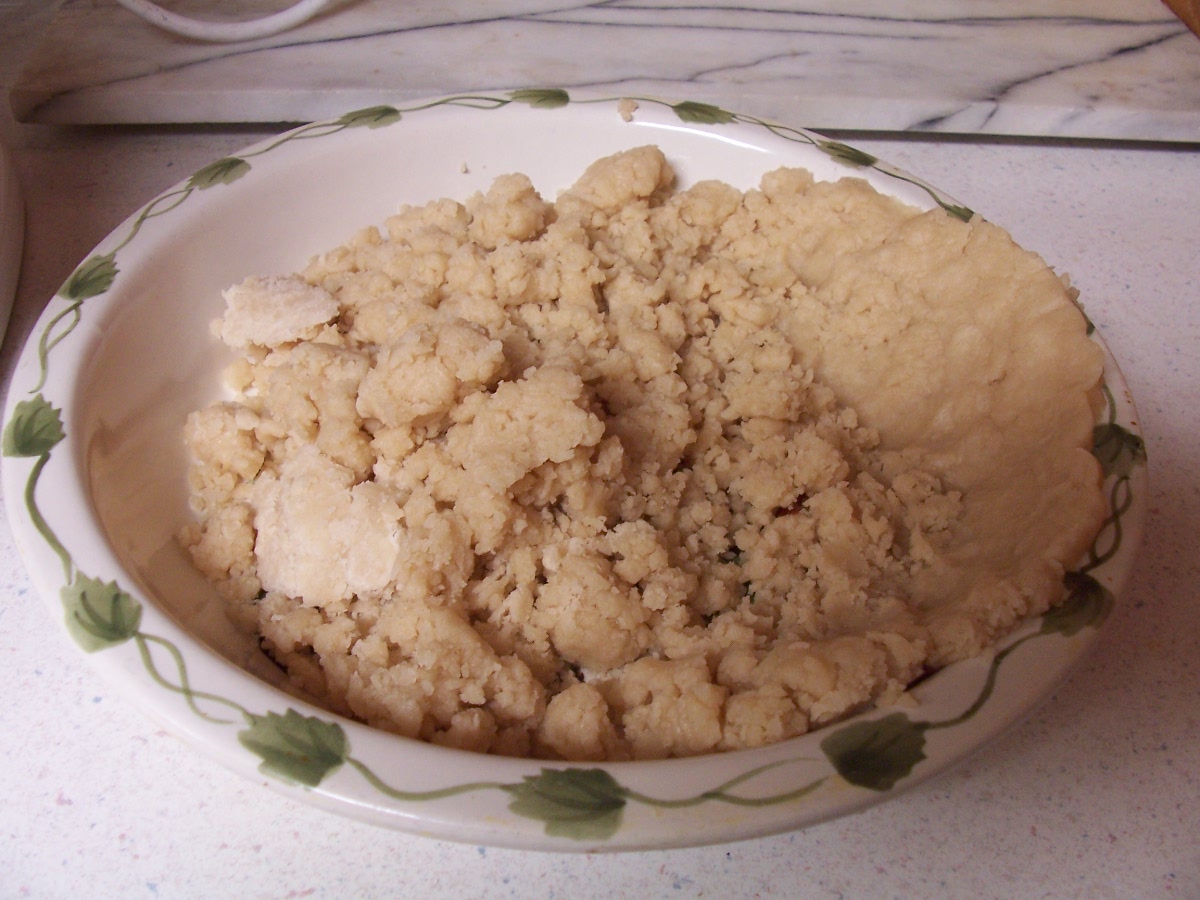
Pop the crust into a preheated 400 degree oven for about ten to twelve minutes.  While you're waiting for the crust to cook, beat 5 large eggs and then add 2 cups milk and mix again.  At this point you add your fixin's; I chopped up half an onion, fried and crumbled up about a quarter pound of bacon and tossed in a handful of goat cheese.  A teaspoon of garlic salt and a few cranks of the pepper grinder.  By the time I was finished with the egg mixture the crust was ready so I poured it right in.  

Once the egg mixture is in the crust, lower the temperature to 350 degrees and bake for an hour.  Remove from oven and let sit for five to ten minutes (if you can), then serve.  


What I really like about the quiche is that it keeps wonderfully in the refrigerator (not so good in the freezer though).  I'll occasionally make one in the evening and put it in the fridge after it has cooled.  The following morning, breakfast is already made and all I have to do is cut a slice for everyone, pop it in the microwave for a minute and breakfast is served!

Friday, March 2, 2012

Hog Totals

We just recently purchased a hog from a local farmer / friend and had it butchered.  Paul picked up most of the meat last week and the remaining smoked & cured meats yesterday so now I have all the totals.  

Although we've purchased pork and beef from local farmers in the past, I've never really done a full accounting of our costs and weights so I was anxious to see what the numbers looked like.

Weights
Approx. live weight of hog: 330 lbs.
Hanging weight* of hog: 230 lbs.
Total packaged meat: 175 lbs.
Total Lard / Fat: 30 lbs.

*eviscerated, skinned, feet & head taken off

Our Costs

Hog: $250
Butchering: $112
Total: $362

Average Local Grocery Store Sale Prices

Chops: 36 lbs. pounds @ $2.43 = $87.48
Roast: 15 lbs. @ pounds $2.49 = $37.35
Ribs: 9 lbs. @ $3.19 = $28.71
Ham Steaks: 18 lbs. @ $2.49 = $44.82
Bacon: 21 lbs. @ $3.54 = $74.34
Sausage: 62 lbs. @ $1.72 = $106.64
Liver: 6 lbs. @ $1 = $6
Neck bones: 4 lbs. @ $1 = $4
Hocks: 4 lbs. @ $1 = $4
Lard: 15 lbs. @ $1 = $15
Fatback: 9 lbs. @ $1 = $9

Theoretical cost of pork products if purchased on sale at local grocery store: $417.34


The prices I listed above are the lowest prices from this week's two local non-Walmart grocery store sale papers.  Couldn't quickly find prices for the neck bones, hocks, lard and fatback so I just used a low price of $1 per pound.  Obviously there are times when one of the stores has a really good sale, but I figured I did enough work getting all the prices in the first place, so this is good enough for me.


So according to my ciphering (that's what they call math down here), we saved about $55.


Really not that much of a savings if you consider the amount we bought and that we have to store all that meat in the freezer (and it costs $$ to run the freezer).  And not only do we have to keep it in the freezer, but we have to make sure we don't let it get "lost" in there and lose any to freezer burn.  The chest freezer we have is big and deep...and currently full.  Even when it's empty I can't get to the bottom corner of it without teetering my midsection on it and lifting my feet off the ground.  For all I know, Hoffa may be hidden in there under a four year old smoked duck.

A very full freezer!  
And I even put all of the ham steaks & bacon in the little chest freezer. 
But we know where the meat came from, we know it's of better quality and we kept money in our community.  It's a great deal in my book.  Or as my Dad would say, "Beats a sharp stick in the eye."

Thursday, March 1, 2012

Location, location, location!

In addition to being almost giddy about filling the freezer with our recent pork procurement....
Oh, pork sausage, how I adore thee, patiently awaiting your destiny.
 Biscuits & Gravy or Sausage Patties with Fried Eggs - I cannot decide.
.....I'm also happy to know that we're practicing good "Eating Ethics".  Not only do we know that this hog was raised in a humane manner, but it keeps money in our local economy; the local farmer and local butcher.  This hog has traveled a total of only twenty-six miles from the farm to the butcher to our house.

Our beef is also acquired and butchered locally; another round trip drive of less than 35 miles.


Getting milk is a simple jaunt across the yard to the barn.  As is gathering eggs; from hens that we hatched out from our own flock.


Cornish Cross meat chickens are raised on our homestead.  Although technically the chicks do have a moderate drive from Southern Missouri to the local feed store, then on to our house.  But it's still "only" a one-hundred and sixteen mile trip.


The occasional deer, squirrel, rabbit and goat also come from our property.  Not a single drop of diesel fuel was used to transport them to our freezer.


Hopefully this spring, summer and fall, the majority of our vegetables will be a short hop, skip and jump to our raised beds.  Then there are those "unplanned" and "freebie" wild foods like plums, grapes, blackberries and persimmons.  Wild greens like henbit, lambs quarters, amaranth, onions, garlic, poke and dandelions.  Clover and lemon balm for herbal teas.  Black walnuts (icky) and Hickory nuts (yummy).   And I'm sure a plethora (hehe) of other goodies I have yet to find, identify or taste.  All this in the uncultivated areas around our homestead or just a short walk down the road.


There is also a seasonal Farmer's Markets on the weekends, one of them just four miles from our house.  
I'd also like to try and do some more bartering with local folk.  Last year I traded our goat milk for fresh fish, pork and venison.

In the "bigger" town, there's a health food store that sells local produce.  Local as in our County or neighboring Counties.  Unfortunately, even some of the big box stores have been using the word "Local" on some of their produce although it means something quite different to them than it does us.  Yes, those apples are located closer than say, Chile, but still two states away.  Not so much local if you asked me.


Now that I've babbled on about purchasing stuff locally, let me be the first to tell you that I still buy apples at the store in the winter and spring.  I buy bananas that were once packed in huge metal cargo containers and floated across the ocean, traveled by rail or semi truck, then delivered to my local grocery store.  Then I will drive the eleven miles (one way) to purchase those bananas, then drive the eleven miles back home.  Just so Rhiannon and I can indulge in a peanut butter and banana sandwich.  


Same could be said for the bulk wheat we purchase.  Even though I grind it into flour in my own grain mill and bake the bread in my own oven therefore saving the actual wheat berries a trip to / from mills and bakeries, the actual wheat has still traveled two thousand miles from a wheat field in Montana to a distribution warehouse in Southern Michigan, then down to us in Arkansas.


Need I mention how far that Earl Gray Tea I drink so often has to travel???


So even though we don't grow our own grains, mine our own salt or have a heated greenhouse large enough to grow our own banana trees, we do what is feisable in order to reduce our dependence on foods that we
are able to produce or buy locally.  It just takes a little more planning.

Wednesday, February 29, 2012

Egg Carton O'Rama

Anyone that owns chickens has probably had to deal with this from time to time:
One of many small towers of egg cartons consuming
the area above my refrigerator, the laundry room, and
any other place I can manage to stuff them.
It seems that once someone knows that you have chickens, they start saving egg cartons for you.  Tons & tons of egg cartons; so many that I think people intentionally buy extra eggs at the store just so they can "gift" me with the cartons.  Maybe it makes them feel better thinking that those egg cartons are not going into a landfill.  And some of them I do re-use.  But let me tell you, especially during spring, I usually have a tower of cartons exceeding me in height (although not in girth or weight.....now that would be an incredible amount of cartons!!)  And although I appreciate the thoughtful intentions, I can only use so many.  Last year I actually put an ad in the paper for them hoping someone else would need them.

On a side note.....why is it that McDonald's got all that flack years ago for having their hamburgers in styrofoam  packaging, but the majority of egg cartons are still made with the stuff?  I'd have to think that more eggs are sold than Big Mac's were.  Or maybe not?  And why are't the cardboard cartons used more?  Probably more expensive?


Anywho.....

So even though I use my fair share of egg cartons and a few leave the house when I sell or give eggs away, there is still a plethora of cartons left.  I've used them in counting games with Rhiannon, for watercolor paints, storing small craft items and this time of year, starting seedlings:

My pathetic attempt; 72 measly seed starts.  But more planned.
Soon, I hope.
Does anyone have any other ideas for these things??  

Tuesday, February 28, 2012

Making Lasagna in a Cold Frame

I've been wanting more raised beds in the front yard.  I also recently mentioned my desire for a small cold frame.  So Paul went through our scrap pile of lumber, dug out the old shower door from underneath a heap of other "future" project materials, got the saw and drill out and made me this handy-dandy little cold frame over the weekend:
Paul was going to hinge the glass door onto the framework, but I asked him not to.  I wanted to be able to take it off during the warmer months and not have to worry about propping the glass up (seemed like an accident waiting to happen with a 3-year old around).  When the plants no longer need the warmth, I'll just put the glass away until Fall. 

Now I had my little raised bed framework and glass top, but I didn't have anything resembling dirt to put into the bed.  Since I haven't yet managed to get enough "dirt" from various locations around the homestead, I decided that this would be a perfect opportunity to try my hand at Lasagna Gardening.  


I put down about six inches of leaves and liberally watered it; my theory being that instead of using cardboard or newspaper (which I didn't have any of) the wet mat of leaves will smother the sod underneath.  Then I put down about 6-8" of wasted hay and watered that down.  


In the next few days, I'll haul some old manure from Ms. Melman & Nugget's pasture and put it in there with another topping of wasted hay, then some goat berries, then finish it off with some semi-finished compost.  Unfortunately I don't have any green stuff to put in the beds, so I'm wondering if I should add anything in lieu of the "live" stuff.


I won't be planting anything in the "lasagna" layers yet, but will be putting containers filled with soil inside the cold frame and planting in those.  As the materials compress, I'll add more layers.


I'm hoping that by fall the lasagna layers will be nice enough to plant some spinach, lettuce and other cool weather leafy veggies in.  Then I'll drag out the glass top again and use it as my cold frame.

Monday, February 27, 2012

Got Poop?

As we live in The Ozarks, "soil" is a relative term around here.  Being born & raised in Illinois, it had never really occurred to me that there were places that didn't have dirt.  If one were to scrape or burn the top covering of greenery from the ground around our homestead, you'd see something that closely resembles a gravel driveway.  Really.

Pounding fence posts requires mechanical assistance.  Falling on the ground isn't something to just shrug off as there is invariably a large rock hidden just underneath the sparse vegetation.  Our first year here we dug holes in the "garden" for the tomato plants using the backhoe.  Really.


What does one do when there is no dirt, but still requires the growing medium to sustain a decent sized garden?


We bought "Super Dirt" (or that's what they called it) from one of the local nurseries a few years ago to fill up the raised beds.  What a disappointment.  This so-called dirt contained a plethora (told you I liked that word!) of sticks, rocks, wood chips and other items, and though technically organic compounds, nothing you would consider actual dirt, let alone "Super" dirt.


I am trying to get a good compost pile going, but it does take time.  And I am not a patient woman.  The fact that I keep moving the compost pile and using it even before it's really done cooking doesn't help.  It also doesn't help that the chickens keep flinging it all over since the pile is never really contained well enough to keep the scratching biddies out of it.


When Paul's running the dozer through the woods, there are spots where I can get some soil, usually directly surrounding the area of a large, downed tree.  So I can screen some decent dirt from that.


But the easiest, and by far the nicest garden amendment comes from here:

and from here:
and is found right in front of the goat / chicken barn:
This area gets a lot of goat berries (nice word for poop) and the occasional chicken turd.  Every morning I sweep the barn floors right out the door.  This area also gets a lot of foot & hoof traffic so stuff is pretty much pre-pulverized.  After a particularly heavy rain, I'll put down some straw so it's not so smooshy.  And about twice a year I collect the already-composted, nutrient-rich material, and "fluff" it up a bit by crumbling up the bigger pieces and adding sawdust or whatever other organic material I can scrounge up around the farm.

Super Dirt?  No thanks.  We got Super POOP!

Saturday, February 25, 2012

Crumbing Right At Ya!


So here's the close up.  

I'm embarrassed to admit that this is the only piece left (it IS much bigger than it looks, it's at a "skinny" angle!).  But hey, it was made Thursday afternoon, and Paul did take a chunk to work, and I gave a hunk to my Mom.....and, and, and.....

Oh hell, we're just a bunch of gluttons.  And I wonder why I'm thirty pounds overweight.  

So, now that you all have an up-in-your-face but-you-can't-eat-it photo, what say ye about the texture?  I have noticed another thing though; the longer the cake sat, the better it got.  

So, is it that I'm just used to the twinkie-like consistency of commercially sold pound cakes?  Possibly.  But honestly, I no longer care about trying to match that texture anymore.  This cake is good enough as is......imperfect looking as it is!